- The
world’s largest apple peel was created by Kathy Wafler Madison
on October 16, 1976, in Rochester, NY. It was 172 feet, 4 inches
long. (She was 16 years old at the time and grew up to be a sales
manager for an apple tree nursery.)
- It
takes about 36 apples to create one gallon of apple
cider.
- An
apple tree will start bearing fruit 8-10 years after it is planted.
A dwarf tree starts bearing in 3-6 years.
- Apples
are a member of the rose family of plants along with pears, peaches,
plums and cherries.
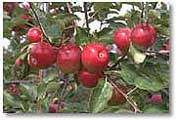
- Apples come in all shades of reds, greens and yellows.
- Two pounds of apples make one 9-inch pie.
- 2500 varieties of apples are grown in the United States.
- 7500 varieties of apples are grown around the world.
- 100 varieties of apples are commercially grown in the United States.
- Apples are grown commercially in 36 states.
- Apples are fat, sodium and cholesterol free. And they taste great too!
- A medium apple has about 80 calories.
- Apples are a great source of pectin, a soluble fiber. One apple has 5 grams of fiber.
- The pilgrims planted the first US apples trees in the Massachusetts Bay Colony.
- The science of apple growing is called pomology.
- Most apples are still picked by hand in the fall.
- Americans eat 19.6 pounds of apples every year.
- 25 percent of an apple’s volume is air, that’s why they float.
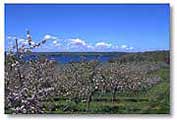
- Most apple blossoms are pink when they open but gradually fade to white.
- Most apple trees can be grown farther north than most other fruits because they blossom late in spring, minimizing frost damage.
- It takes the energy from 50 leaves to produce one apple.
- Apples are the second most valuable fruit in the United States. Oranges are first.
- The largest U.S. apple crop was 277.3 million bushels in 1998.
- Archeologists have found evidence that humans have been enjoying apples since 6500 BC.
- Newton Pippin apples were the first apples exported from America in 1768, some were sent to Benjamin Franklin in London.
- In 1730 the first apple nursery was opened in Flushing, New York.
- One of George Washington’s hobbies was pruning his apple trees.
- A peck of apples weight 10.5 pounds.
- A bushel of apples weight 42 pounds and will yield 20-24 quarts of applesauce.
- Apples ripen or soften ten times faster at room temperature than if they were refrigerated.
|
|
|
|
| Click
on the Photos to Learn More! |

If
you like bugs,
you could be an entomologist. Entomologists are insect specialists
that help growers identify the good and bad bugs in their orchards.
They also recommend ways to control bad bugs so they don’t damage
apple trees.
If
you like machines, you could be an apple grower, apple packer
or apple processor. Apple growers use sprayers, mowers and other
machines in the orchards. Apple packers use large machines to wash,
sort and pack apples for customers. Apple processors use many different
kinds of machines to make apple juice, applesauce and other apple
products.
If
you like trucks, you could be an apple hauler. Haulers drive
to farms and packing houses, load their trucks with apples and deliver
them to supermarkets, processors and other customers.
If
you like supermarkets, you could be a produce manager or apple
buyer. Produce managers take care of the fruit and vegetable section
in the supermarket. Apple buyers work with apple growers and apple
shippers to get apples for the supermarket to sell.
If
you like to sell, you could be an apple shipper. Apple shippers
sell apples to supermarkets, restaurants, school cafeterias and
other places. They sell apples in many countries including England,
Israel, Canada and Costa Rica.
If
you like to play “store”, you could be a farm market manager.
Farm marketers sell apples and other produce at farm stands and
country markets. Many farm markets also provide fun activities for
their customers such as pick-your-own apples, wagon rides, playgrounds
and harvest festivals.
|